|
4 Versions of the Rules:
- Watch Andy's video on how to play a Sample Treehouse Game.
- Click
here for a PDF of the new rules insert
that is included in each tube.
- Click here for the rules
as they appear on the sides of the First Edition Treehouse tube
- Read the rest of this page for an HTML version
of the rules
|

Equipment
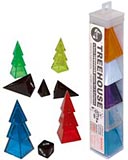
All you need to play is a Treehouse
set. (You can also play with any stash of stackable Icehouse
pieces and a standard 6-sided die.) Complete Treehouse sets
are available from Looney
Labs in 2 color schemes, Rainbow and Xeno.
|
Setup
Everybody gets a Tree:
Each player gets a trio of pieces, which begin in the classic
"Tree" formation.
As shown here, a Tree is a Small on a Medium on a Large.
|
|
This is the House:
One extra trio is set in the center of the table, arranged
with the Small standing up and the Medium and Large pieces on
opposites sides of the Small, lying down and pointing away from
each other, as shown above.
|
|
Goal
The object of the game is to rearrange your trio of pyramids
to match the current arrangement of the House.
Who
Goes First?
Whoever's holding the die goes first!
How to Play
Each trio occupies its own line of 1-3 spaces. All lines run
parallel. Pieces can only ever point upright, to the left, or
to the right, and pieces stack only if upright. On a Hop or Dig,
pieces may be placed between others,
or at the end of the line; close up all gaps in the line after
performing the action.
Possible Actions
On your turn, roll a six-sided die. If you can
do this action to your own trio, you must. If not,
you may do the action to the House. If you cannot
do anything, roll again.
|
| TIP |
 |
Knock over any upright piece or stack. A tipped stack then
separates, all pointing one way. (You can only tip the whole
tower -- you can't "tip-off" the top piece.) |
| SWAP |
 |
Choose two pieces. They switch places. Pieces only reorient
if entering a stack. (Yes, two pieces within a single stack may
be swapped.) |
| HOP |
 |
Any upright piece jumps up, landing upright in any spot in
the line. Stand up anything it lands on. (If the hopping piece
wasn't on top, whatever was goes along for the ride.) |
| DIG |
 |
A sideways piece tunnels down and surfaces upright in place
or at any spot along the line in the direction it was pointing.
Stand up anything it rises underneath. |
| AIM |
 |
Re-orient a solitary piece, pointing it up, left or right. |
| WILD |
 |
Choose any of the five actions above, and apply it to your
trio or the House. |
|
|
Notes
No Passing: You cannot pass (even on a Wild) if there's
some way for you to do the indicated action to your trio. If
you can't do anything, you have the option to do the action to
the House, but you can choose to pass on that
action if you wish. Note that Hopping and landing in the same
spot is considered a pass and is not permitted.
Winning: As soon as your trio matches exactly
the arrangement of the House, you win! You can win even if it's
not your turn. If two people match the House at once, victory
goes to the person who took the turn that created the win.
Analogy: Here's a fun way to think about this game:
it's kind of like Fluxx!
Your Keepers are your trio of pyramids, and the Goal is the configuration
of the House. You can win either by changing the Goal to match
your Keepers, or getting the Keepers that match the current Goal.
The Rules -- i.e. the things you're allowed to do during your
turn -- change with each turn with a roll of the die, and sometimes
you are required to perform an Action you don't really want to
do. Lastly, you never know who's going to win until someone does!
|
| |
|
|